
This HTML edition reproduces the original white paper, published October 10, 2025. Its figures, product descriptions, and forward-looking statements reflect the original edition. The original PDF remains available above.

“AI can and must be built on respect for content. Proportional attribution is the only way to ensure creators are fairly credited and compensated in the AI era.”
Bill Gross
Founder & CEO, ProRata
Executive summary
Generative AI is reshaping how information is accessed and consumed, but in doing so it is undermining the economic foundations of original content creation.
As AI systems summarize and reproduce journalism without attribution to sources, publishers experience declining traffic, eroded visibility, and weakened incentives to invest in quality reporting. Establishing reliable, proportional attribution is therefore essential to restore accountability, transparency, and sustainability within the information ecosystem. Attribution connects AI outputs to their sources, ensuring that value and credit flow appropriately to those who produce the underlying work.
ProRata’s attribution system, as described in this paper, provides a scalable, auditable solution that quantifies the contributions of various content sources and enables output-based pay-per-use compensation—offering a model for a more ethical and sustainable relationship between AI and the creative industries.
Introduction: restoring visibility in the age of AI
Publishers and content creators have been told a single, consistent story: attributing the contribution of sources to generative AI answers or chats is impossible. The systems are too complex, the math too opaque, the signals too diffuse. The prevailing narrative argues there is no way to trace where content came from, or who deserves the credit. It’s a black box.
The implication is stark: journalism is reduced to fuel for AI, stripped of its independent value. It has already been consumed—accept it and move on. This narrative demands that creators surrender control of their work, with no credit or compensation.
This white paper is our rebuttal.
We categorically reject the claim that claim-level attribution, and the fair compensation it enables, is unworkable. Other media sectors have solved this at scale. Spotify compensates rights holders per stream. YouTube shares revenue per view. Apple News licenses content and distributes subscription revenue. In every case: usage is measured, rights are recognized, and payment follows.
Content attribution for generative AI is no longer theoretical, it’s a reality. At ProRata, we’ve built and deployed a system that assigns fair, proportional credit to the sources behind AI outputs and powers a scalable pay-per-use revenue-sharing model. The result: attribution has moved from an aspirational ideal to a proven, functional standard.
In this short paper, we will describe how we deliver proportional attribution across hundreds of publications and present a clear path to restore control to the creators whose work powers the web. This paper is also a declaration: content attribution is the cornerstone of responsible and ethical generative AI. Without it, we lose more than credit, we lose the economic foundation that sustains quality content. With it, the principle is simple: when you can track who contributed value, you can compensate them appropriately. Attribution is the only mechanism that secures long-term viability for publishers and creators alike.
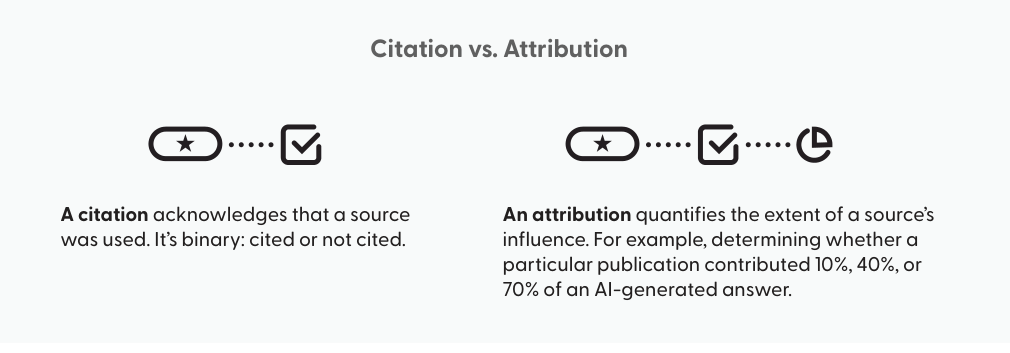
Citation
A citation acknowledges that a source was used. It’s binary: cited or not cited.
Attribution
An attribution quantifies the extent of a source’s influence. For example, determining whether a particular publication contributed 10%, 40%, or 70% of an AI-generated answer.
When AI takes without giving back
Generative AI is not a distant disruptor; it’s already dismantling the economic foundation of digital publishing.
For years, publishers navigated an imperfect but functional system. Audiences discovered content through search, social media, and aggregators. Page views fueled advertising. Link-backs sustained visibility. It wasn’t ideal, but it was survivable.
That structure is now collapsing. AI-powered search delivers direct answers without clicks, using summaries built from the very articles it displaces. Bylines vanish. Citations are vague or fabricated. Traffic is siphoned, and the original author and publisher become unidentifiable.
The scale is quantifiable; the numbers are a wakeup call for the entire publishing industry:
- AI extracts but doesn’t return: Cloudflare reports a staggering 1,700:1 crawl-to-referral ratio for OpenAI, while Anthropic’s ratio is even more extreme at 73,000:1.1 And Google now scrapes roughly 14 pages for every referral, compared to just 2:1 a decade ago.2
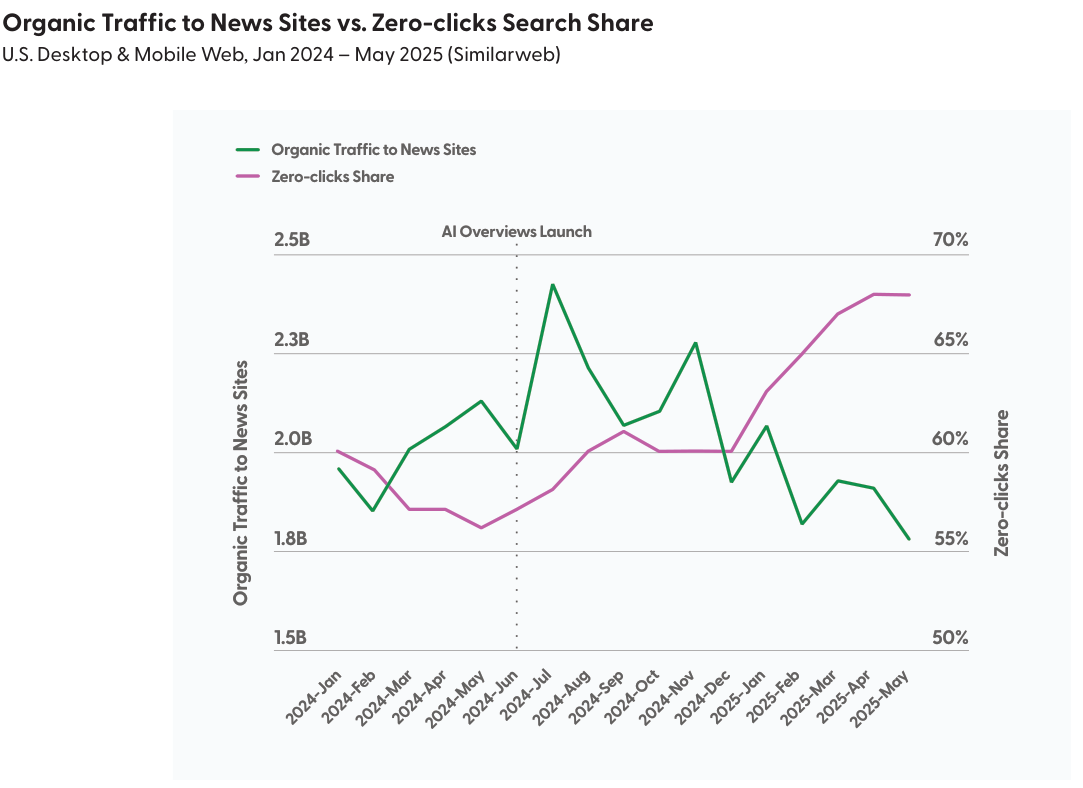
- Emerging zero-click dominance: Users increasingly consume without leaving the search page. SparkToro finds that 58% of Google queries end without a click, while AI-native platforms like ChatGPT, Perplexity, and Claude are capturing a growing share of discovery time.3
- Publisher traffic collapse: Major publishers are already reporting double-digit traffic drops. Digital Context Next reports 10% to 25% year-over-year drops in referral traffic for brands including Condé Nast, Future, Immediate Media, and Hearst Magazines— largely due to Google AI Overviews.4
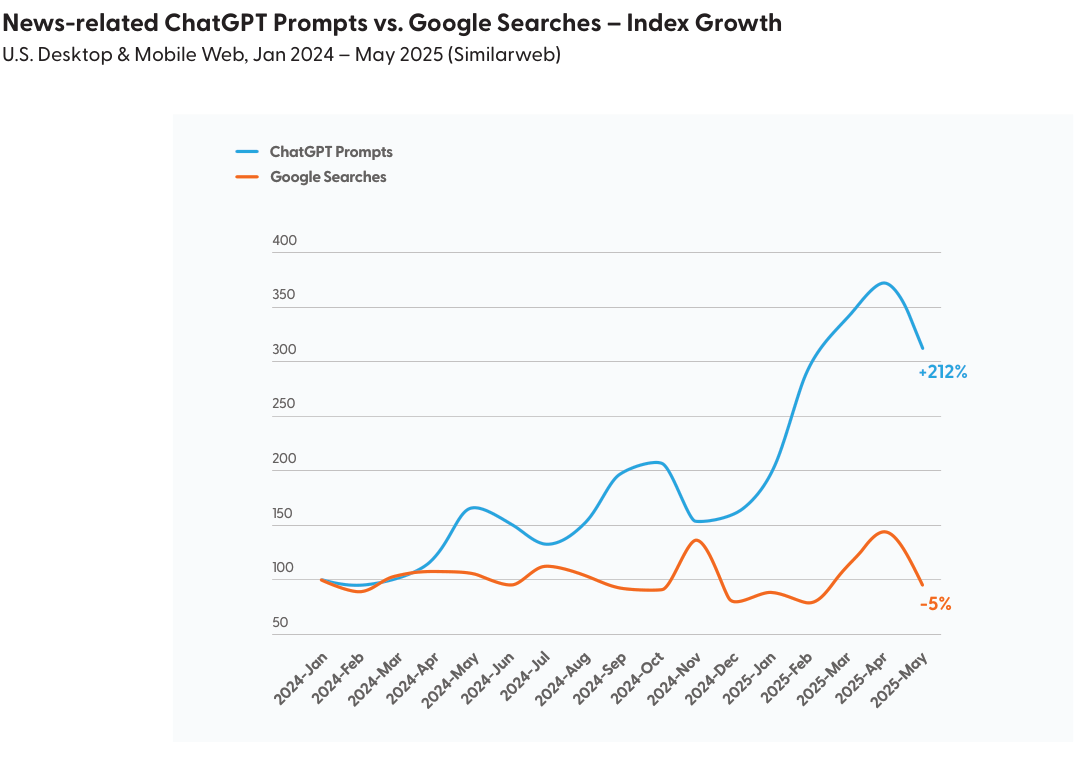
- AI search adoption accelerates: Consumer behavior is shifting rapidly toward AI-native platforms. The Wall Street Journal notes that tools like ChatGPT and Perplexity now account for 5.6% of U.S. desktop search traffic, more than double their share just a year earlier. Among early adopters, nearly 40% of searches bypass traditional engines entirely.5
For many publishers, the damage is no longer theoretical: double-digit visitor declines, fading brand visibility, weaker audience relationships, and shrinking ad revenue — even as operating costs remain high. Without immediate change, we risk entering a future where journalism survives only as raw fuel for machines.
Attribution as the engine of sustainability
Attribution is not just a courtesy. It’s the mechanism that makes original content visible, valuable, and viable.
In the generative AI era, the absence of attribution to original sources carries outsized consequences. When AI systems produce answers without clear provenance, they sever the link between information and its origin. What remains may sound authoritative, but it floats without context. Claims cannot be evaluated, verified, or monetized.
Even when citation links appear, they are often partial, perfunctory, or incomplete. Attribution, in its purist form, essentially says: “For this output, this is the proportionate value of XYZ source.” By doing so, attribution serves five key functions:
- Builds trust. In an era of hallucinated facts and automated spin, audiences need to know exactly who said what. Attribution anchors answers in real reporting, allowing readers to verify information at its source
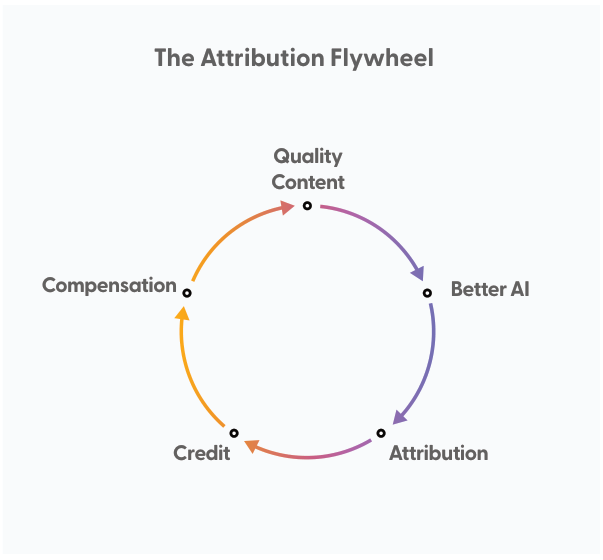
- Enables output-based usage compensation. By fairly assigning contribution, attribution ensures that the compensation can be distributed proportionately on a per-use basis
- Supports quality content. Without credit, there is little incentive to invest in depth, accuracy, or originality. Attribution keeps those values economically viable
- Protects brand identity. Publishers build trust through consistency, voice, and editorial rigor. Attribution ensures their brand remains visible in the reader’s journey, sustaining relevance and reputation
- Promotes transparency. Generative AI systems typically ask users to accept answers on faith. Attribution reveals the origin of claims and enables scrutiny and critique, which provides the necessary feedback to both improve systems and protects from disinformation, accidental or otherwise
We believe attribution is not optional. It is the foundation of a sustainable information ecosystem that values and respects content creators.
How we deliver proportional attribution
Some AI search platforms display citations, but rarely if ever provide full attribution for each claim in a response. The limitation is structural. Foundation models are trained on vast, unlabeled, and often scrambled text where document boundaries and authorship are not preserved. When the model generates a sentence, it has no internal record of where each fact originated. Instead, citation links are usually appended afterward by heuristic rankers (best guesses rather than verified matches) or retrieved from external search results through a process known as Retrieval Augmented Generation.
To deliver attribution that is auditable, measurable, and capable of supporting fair compensation, ProRata takes a different path: output-based attribution. For every AI-generated answer, our systems:

- Identify discrete, individual claims
- Match and verify each claim against an indexed corpus
- Assign value weights based on multiple signals, including:
- Originality / pedigree: Outlets that break a story or contribute unique reporting receive higher weight
- Specificity: Clear, direct statements outweigh vague or indirect references
- Commonality: The more widely a claim is repeated across documents, the less any single outlet retains unique claim to value (a universally known fact carries little distinctive weight)
- Aggregate results. Signals combine into proportional contribution scores. These roll up from claims to articles to publishers, producing a transparent snapshot of who contributed—and by how much—to a given answer.
The resulting attribution scores provide a proportional view of each publisher’s contribution to the generated content, which in turn can be used to determine payout calculations.
Since 2024, our attribution platform has processed millions of prompts, calculating the relative contributions of hundreds of publications. Our system proves that attribution is not only possible, but operationally scalable, establishing the basis for a fair and sustainable information economy.
Future work
As generative AI continues to change how information is sourced, interpreted, and monetized, it is imperative that a robust and repeatable attribution model reliably records and fairly rewards the work of original creators. We are committed to making our attribution methodology and platform an industry standard. Achieving this vision will require continuing innovation, collaboration, and the resolution of several key challenges, including but not limited to:
- Growing the corpus of our licensed partner network (which currently covers over 750 publications and data sources) to ensure accurate and robust attribution; a larger trusted corpus enables more reliable detection and tagging of unsupported claims, also known as ‘hallucinations,’ in generated responses.
- Easing the adoption and integration of our attribution technology by third-party developers by providing robust APIs, frameworks, and support.
- Continuing to expand and integrate our existing attribution capabilities for audio, music, image, and multi-modal content.
- Recognizing the march toward AGI depends not only on a deeper understanding of content, but also on the continued production of high-quality, original work.
Generative AI offers an exceptionally rich environment for innovation in attribution. The opportunities are too numerous to fully describe here; we expect this agenda to continue to expand in the years ahead.
The time to act is now
The rise of generative AI does not have to spell the end of sustainable, creator-driven publishing as long as attribution is treated as a core principle. We invite publishers, AI developers, and policymakers to join us in making proportional attribution a standard for generative AI. The technology exists (see it live at chat.gist.ai), the model is scalable, and the time to act is now. Every day without fair attribution accelerates the erosion of quality content and public trust.
Together, we can ensure that every fact, every insight, and every piece of original reporting is credited and compensated — so that AI innovation strengthens rather than erodes the foundation of our information ecosystem.
References
- Control content use for AI training with Cloudflare’s managed robots.txt and blocking for monetized content, The Cloudflare Blog, July 1, 2025 Back to text
- The AIpocalypse is here for websites as search referrals plunge, The Register, June 22, 2025 Back to text
- Nearly 60% of Google searches end without a click in 2024, Search Engine Land, July 2, 2024 Back to text
- Google AI Overviews linked to 25% drop in publisher referral traffic, new data shows, Digiday, August 15, 2025 Back to text
- AI Search Is Growing More Quickly Than Expected, The Wall Street Journal, July 22, 2025 Back to text
© 2025 ProrataAI, Inc. All rights reserved.